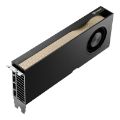
Transform Workflows With Next-Level Workstation Performance
As AI continues to advance at an incredible pace, industries face mounting pressure to harness its transformative power and adopt tools capable of handling generative AI, real-time simulation, and hyperrealistic rendering. Enterprises need solutions that combine breakthrough performance, scalability, and versatility to tackle the rise of increasingly complex workloads—from training domain-specific AI models to rendering billion-polygon engineering designs or simulating real-world physics with
pixel-perfect accuracy.
Unlock next-level AI performance and neural rendering capabilities with NVIDIA RTX PRO™ 5000 Blackwell GPUs. Built on the NVIDIA Blackwell architecture and equipped with 48 or 72 GB of ultra-fast GDDR7 memory, it accelerates everything from AI development, large language model (LLM) inference, and generative AI workflows, along with high-fidelity simulations, video production, and complex 3D modeling from your desktop. With twice the memory of the last generation, you can work with big data, make complex 3D models, and run AI-enhanced multi-app workflows without interruption.
With transformative AI performance gains over the previous generation, you can run complex generative AI workflows more efficiently using the new FP4 data format, which reduces memory demands. Accelerate graphics workloads with dramatic speed boosts to design hyperdetailed vehicles, immersive VR environments, and lifelike renders faster than ever. Streamline video production pipelines with up to three encode and three decode engines that support 4:2:2 color formats and multistream workflows.
With the RTX PRO 5000, seamlessly run local AI assistants, craft photorealistic visuals with neural rendering, and optimize precision-critical simulations for engineering and scientific research, all with unmatched stability and speed.
Breakthrough Innovations
The NVIDIA Blackwell architecture combines breakthrough AI, ray tracing, and neural
rendering technology, with massive performance and memory improvements to drive
cutting-edge professional creative, design, and engineering workflows and power the
next decade of innovation.
NVIDIA Blackwell Streaming Multiprocessor
The new SM features increased processing throughput, and new neural shaders that integrate neural networks inside of programmable shaders to drive the next decade of AI-augmented graphics innovations.
5th Gen Tensor Cores
Deliver up to 3X the performance of the previous generation
and support for FP4 precision for faster AI model processing times with reduced
memory usage, enabling local fine-tuning of LLMs and generative AI.
4th Gen Ray Tracing Cores
Double the ray-triangle intersection rate of the previous
generation to create photoreal, physically accurate scenes and immersive 3D designs with RTX Mega Geometry, which enables up to 100X more ray-traced triangles.
Next-Gen Video Engines
Enhance video conferencing, video production, and
streaming workflows with real-time AI processing. Ninth-generationNVENC and the sixth-generation NVDEC engines provide support for 4:2:2 encoding and decoding to explore a new realm of high-resolution video workflows.
GDDR7 Memory
New and improved GDDR7 memory significantly boosts bandwidth and capacity, empowering your applications to run faster, and work with larger, more complex datasets. With 96 GB of GPU memory and 1.8 TB/s bandwidth, tackle massive 3D and AI projects, fine-tune AI models locally, explore large-scale VR
environments, and drive larger multi-app workflows.
DLSS 4
Multi Frame Generation ensures ultra-smooth frame pacing for lifelike simulations. Experience up to 3X faster frame rates and stunning image quality in supported game engines and 3D rendering applications for smoother, more responsive performance.
PCIe Gen 5
Support for PCIe Gen 5 provides double the bandwidth of PCIe Gen 4, improving data-transfer speeds from CPU memory and unlocking faster
performance for data-intensive tasks like AI, data science and 3D modeling.
DisplayPort 2.1
Achieve unparalleled visual clarity and performance, driving highresolution displays at up to 8K at 240 Hz and 16K at 60 Hz. Increased bandwidth
enables seamless multi-monitor setups, ideal for multitasking and collaboration, while HDR and higher color depth support ensures superior color accuracy for precision work, such as video editing, 3D design, and live broadcasting.
Universal MIG
Split a single RTX PRO 6000 Max-Q into multiple isolated instances,each with its own resources, allowing for concurrent execution of multiple
workloads, optimized GPU utilization, and secure isolation of different applications or users.