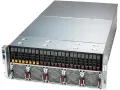
NTS Elite APEX 4U AMD Instinct MI300A AI/HPC Server
Product Overview
The NTS Elite APEX 4U AMD Instinct MI300A AI/HPC Server is designed for demanding artificial intelligence, high-performance computing (HPC), scientific research, and compute-intensive workloads. Based on the Supermicro AS-4145GH-TNMR platform, this 4U rackmount system supports an architecture built around four AMD Instinct MI300A accelerated processing units (APUs).
The MI300A combines AMD CPU and GPU compute resources with shared high-bandwidth memory in a unified package. This architecture can help reduce data movement between CPU and GPU memory, making it well suited to workloads that require intensive parallel processing, large datasets, and close coordination between general-purpose and accelerated computing.
New Tech Solutions (RackMountNTS) provides engineer-to-order system configuration and deployment support, helping customers evaluate platform requirements, workload compatibility, power and cooling constraints, and infrastructure integration before deployment.
Key Technical Features
4U rackmount platform: A high-density server form factor designed for data center and enterprise computing environments.
Four AMD Instinct MI300A APUs: Accelerated computing architecture combining CPU and GPU resources within each APU.
Unified CPU/GPU memory architecture: Shared high-bandwidth memory within the MI300A helps support data-intensive workloads and reduce certain CPU-to-GPU data transfers.
AI and HPC acceleration: Designed for demanding parallel-computing applications, scientific simulations, advanced modeling, and compatible AI workloads.
Data center integration: Intended for rack-based infrastructure deployments where system power, cooling, networking, and operational requirements must be evaluated together.
Engineer-to-order deployment support: NTS can assist with reviewing system requirements and coordinating configuration, validation, and delivery planning.
Refer to the manufacturer's specifications for confirmed processor details, memory capacity, storage and networking interfaces, power requirements, cooling options, and supported configurations.
Benefits of the AMD Instinct MI300A Architecture
CPU and GPU Computing in One APU
The MI300A integrates CPU and GPU compute resources into a unified architecture. This can simplify data sharing between processing resources for compatible applications and help reduce overhead associated with moving data between separate CPU and GPU memory domains.
High-Bandwidth Memory for Data-Intensive Workloads
The integrated high-bandwidth memory architecture is designed to support workloads that need rapid access to large volumes of data. Performance depends on the application, software implementation, memory requirements, and workload characteristics.
Accelerated Scientific and Engineering Computing
The combination of CPU and GPU resources is suitable for applications that combine sequential processing, parallel computation, numerical analysis, and large-scale simulation. Software compatibility and optimization should be evaluated for each target workload.
Rack-Dense Accelerated Computing
The 4U form factor provides a rackmount deployment option for organizations building accelerated computing infrastructure. Before deployment, operators should confirm rack space, power delivery, cooling capacity, and facility-level thermal requirements.
Applications and Use Cases
Artificial Intelligence and Machine Learning
Suitable for evaluating compatible AI training, inference, and large-scale tensor-computing workloads. Actual performance depends on the model, software framework, precision, memory requirements, and optimization.
High-Performance Computing (HPC)
Designed for compute-intensive workloads such as scientific computing, numerical modeling, complex simulations, and research applications that benefit from accelerated processing.
Scientific Research and Computational Modeling
Can support research environments working with large datasets, mathematical models, computational physics, and other parallel-processing applications, subject to software compatibility.
Engineering and Simulation
Potential applications include computational fluid dynamics, materials research, and engineering simulations that can take advantage of the MI300A's CPU/GPU architecture.
Data-Intensive Analytics
Suitable for compatible analytical workloads that process large datasets and require substantial computational throughput and memory bandwidth.
Research and Academic Computing
Universities, laboratories, and research organizations can evaluate the platform for specialized accelerated-computing clusters and experimental AI/HPC environments.
System Configuration and Deployment
The appropriate system configuration depends on the intended workload, application software, facility infrastructure, and deployment objectives. NTS works with customers to review requirements and establish a suitable configuration and deployment plan.
Key considerations include:
Workload type, application requirements, and software compatibility.
CPU/GPU compute architecture and memory requirements.
Supported storage capacity, drive interfaces, and data throughput.
Supported Ethernet or InfiniBand networking options, where available.
Rack space, electrical capacity, power distribution, and cooling requirements.
Operating system, firmware, driver, and application deployment requirements.
Delivery schedule, acceptance procedures, and lifecycle support needs.
Availability of individual options must be confirmed against the specific platform configuration and manufacturer's documentation.
NTS Engineer-to-Order Services
New Tech Solutions (RackMountNTS) supports commercial, federal, defense, and state and local government (SLED) customers with system selection, configuration planning, and deployment coordination.
For the NTS Elite APEX 4U AMD Instinct MI300A AI/HPC Server, customers can share their target workloads, application requirements, infrastructure constraints, networking preferences, and delivery expectations. NTS can then review the requirements and determine the appropriate supported configuration, validation scope, and delivery plan.
The deployment process may include:
Requirements review: Identify workload objectives, software dependencies, and infrastructure constraints.
Configuration review: Evaluate supported system components and platform compatibility.
Power and cooling assessment: Review facility requirements against the proposed configuration.
System validation planning: Coordinate applicable firmware, driver, operating system, and application-readiness checks.
Delivery and acceptance: Establish documentation and acceptance requirements appropriate to the order.
Specific testing, validation, and support deliverables are subject to the agreed scope of work.
Government and Enterprise Procurement
NTS works with commercial, federal, defense, and SLED buyers to support procurement planning for eligible computing infrastructure. Where applicable, customers can discuss contract vehicles, bill-of-materials requirements, sourcing considerations, delivery schedules, and receiving documentation.
Federal and government procurement arrangements, including SEWP V, ITES-4H, GSA MAS, or cooperative purchasing vehicles, should be confirmed for the particular product, contract holder, ordering organization, and solicitation requirements.
Commercial customers can follow the same requirements-review and deployment-planning process, with deliverables tailored to their purchasing and operational needs.
Request a Quote
Planning an AI or HPC deployment? Contact NTS with your intended applications, required compute capabilities, storage and networking needs, rack and facility constraints, and target delivery date.
The NTS team can review the requirements, confirm available platform options, and provide a quotation with applicable lead times, configuration details, validation scope, and delivery documentation.
Related Resources
From research deployments to production computing infrastructure, NTS helps customers coordinate platform selection, configuration planning, and deployment requirements around their intended workloads.