9 min read
 The Ultimate 2026 Buyer's Guide to Rackmount GPU Servers for Generative AI and HPC
Here's The Ultimate 2026 Buying Guide for Rackmount GPU Servers for Generative AI and HPC. Explore NVIDIA HGX B200 with Liquid Cooling and Custom Configurations that Surpass Competitors. This guide will help you plan upgrades, evaluate options, and make confident deployment decisions.
Relying on 2024 infrastructure for upcoming AI workloads creates an immediate performance bottleneck.
There is a strong need for fast rackmount GPU servers that are ready for 2026.
These servers are important because they will help users manage the big 15 times speed boost of the Blackwell design compared to older versions.
Older cooling methods worked well for earlier models, but the NVIDIA HGX B200 needs a new way to stop its powerful computer from getting too hot.
Industry data shows that using old thermal management methods is a big operational risk, not a safe choice.
The superior energy efficiency of liquid cooled AI hardware turns potential power constraints into your strongest competitive advantage.

Why the NVIDIA HGX B200 is the 2026 Standard for Large Language Models
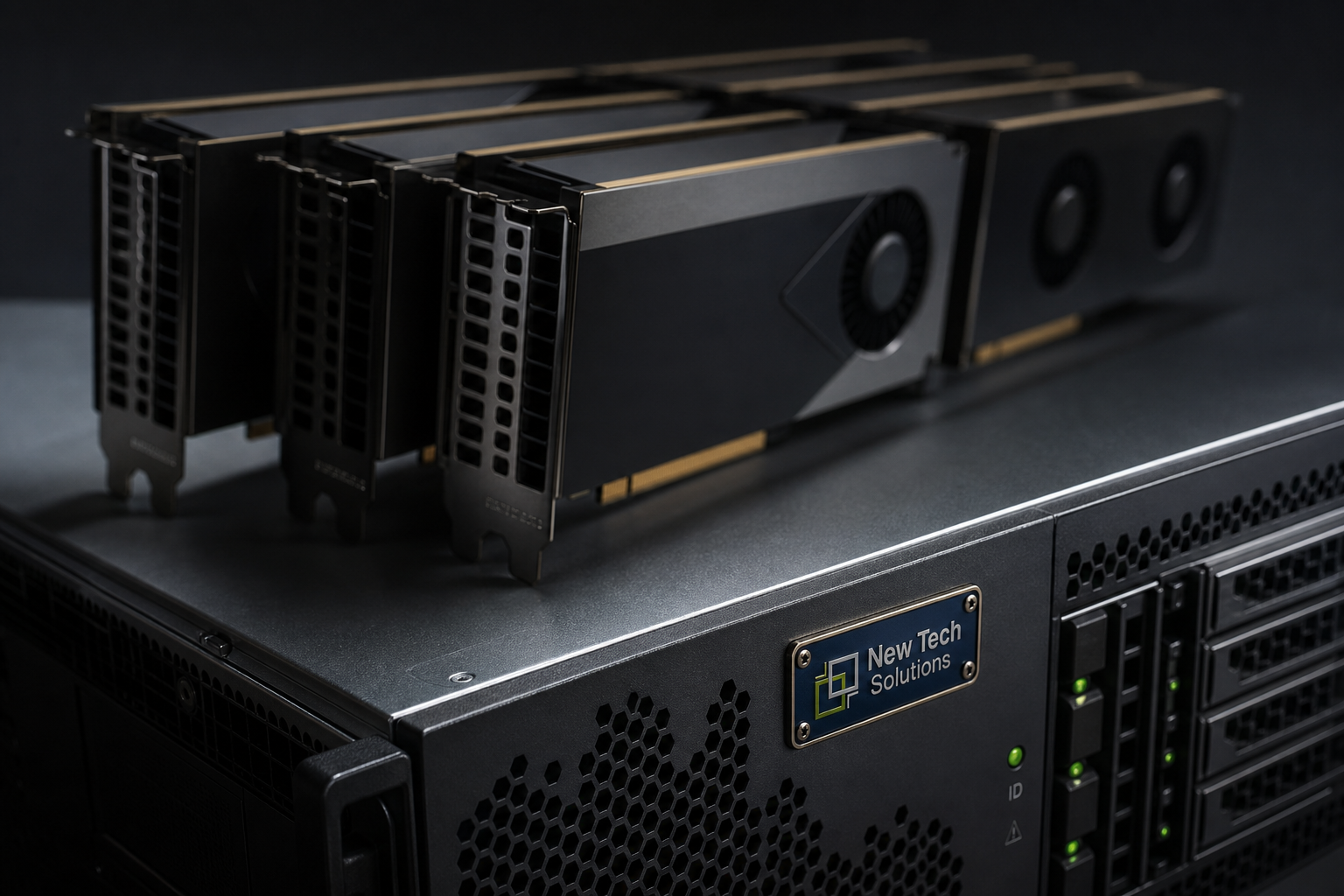
In the past, scaling AI meant simply buying more individual chips and hoping they could coordinate effectively. For 2026's trillion-parameter models, however, that approach creates a digital traffic jam. The NVIDIA HGX B200 solves this by fusing eight separate GPUs onto a single system board using the NVLink Switch System. Instead of eight distinct specialized math engines trying to shout across a crowded room, NVLink acts as a high-speed superhighway, allowing the entire board to function as one massive, unified brain. This integration is the only way to handle the sheer size of modern AI workloads without stalling. In dense rackmount servers, this cohesion is essential.
This architectural shift is critical because today's models are far too large to fit inside a single chip's memory. If data cannot move between processors instantly, your expensive infrastructure sits idle waiting for information. The B200 utilizes HBM3e (High Bandwidth Memory) to deliver data at speeds that make previous generations look sluggish. It is the difference between filling a swimming pool with a garden hose and using an industrial aqueduct; the faster you feed the system, the faster it generates revenue.
Comparing the Leap in Capabilities:
- Memory Bandwidth: 8 TB/s (B200) vs. 4.8 TB/s (H200) --- Eliminates data bottlenecks to keep the "brain" active.
- Training Speed: 4x faster performance --- Reduces model development time from months to weeks.
- Energy Efficiency: 25x better performance per watt --- Drastically lowers the operational cost per query.
Harnessing this immense computational density creates a new physical challenge: extreme heat generation. While the HGX B200 is an engineering marvel, packing this much power into a standard server rack pushes thermodynamics to the breaking point, rendering traditional fans obsolete.
The End of Air Cooling: Why Direct-to-Chip Liquid Cooling is Now a Business Necessity
To manage the temperature of 2026 hardware, it is important to understand a key measurement: Thermal Design Power (TDP).
This figure represents the maximum amount of heat a component generates under load, and for the B200, it reaches levels that traditional fans simply cannot disperse. Air cooling relies on pushing massive volumes of ambient air over hot components, and in rackmount gpu designs, air acts more like an insulator than a coolant. If the heat isn't removed instantly, the hardware forces itself to slow down---or "throttle"---essentially turning your multimillion-dollar investment into a budget server to prevent it from melting.
Direct-to-chip (D2C) liquid cooling solves this physics problem by placing a conductive "cold plate" right on the silicon, functioning much like a radiator in a high-performance vehicle. By circulating fluid directly over the hottest points, businesses dramatically improve their Power Usage Effectiveness (PUE), the industry standard for measuring data center efficiency. Instead of wasting expensive electricity on thousands of screaming fans that struggle to keep up, the energy goes strictly toward powering the AI workload itself, significantly lowering the total cost of ownership over the life of the system.
Adopting direct-to-chip liquid cooling for GPU clusters is no longer an exotic science project; it is a financial requirement for maintaining effective thermal management solutions for high density AI racks. Air cooling has become a liability that burns power without adding value. With the thermal environment stabilized, the next challenge becomes architectural: deciding whether to buy a generic pre-made system or engineer a solution tailored to your specific facility.

Off-the-Shelf vs. Bespoke: Building a Custom Rackmount Server That Beats Generic Clusters
Installing a state-of-the-art NVIDIA HGX B200 into a standard chassis is like putting a Formula 1 engine into a family minivan; the engine works, but the car cannot handle the performance. The primary risk in 2026 isn't just overheating, but "GPU Starvation"---a scenario where your expensive processor sits idle because it is waiting for data to arrive. High-performance rackmount gpu servers must be engineered so that information flows as fast as the AI can "think," ensuring you get every dollar of performance you paid for rather than letting a multimillion-dollar asset wait in traffic.
A custom liquid cooled rackmount server design focuses on three critical pipelines that generic builds often neglect:
- Networking (The Traffic Control): Utilizing high-speed InfiniBand or Ethernet ensures "East-West" traffic---data moving laterally between GPUs---flows without congestion.
- Storage (The Fuel Line): Specialized NVMe drives must feed data instantly to the processor, matching the massive throughput of the B200.
- Power (The Grid): Custom power distribution units (PDUs) are required to safely manage the intense, sudden voltage spikes typical of modern AI training workloads.
Ignoring these supporting elements creates a bottleneck where the hardware throttles itself not due to heat, but due to a lack of resources. Addressing the unique rackmount server power requirements for Blackwell GPUs ensures the system runs at peak capacity 24/7 across modern rackmount servers. Once the technical architecture is stabilized, the conversation naturally shifts to the bottom line: understanding how these upfront choices dramatically alter the long-term financial picture.
The 2026 CFO's Checklist: Calculating Total Cost of Ownership Beyond the Hardware Sticker Price
Purchasing an AI supercomputer often feels like buying a corporate jet; the initial check is large, but the fuel and maintenance determine the actual price tag. In the specific context of total cost of ownership for Blackwell GPU servers, energy bills can easily eclipse the hardware cost within three years if efficiency is ignored. While traditional air-cooled setups waste electricity fighting heat, liquid cooling acts like a hybrid engine, reclaiming that energy to drastically lower operational expenses and improve performance per watt.
Financial planning for an enterprise AI server procurement guide 2026 requires looking beyond immediate quarterly results to ensure hardware longevity. Integrating HGX B200 into existing data centers without upgrading infrastructure is a recipe for early obsolescence, as underpowered racks limit the functional lifespan of the equipment. By investing in robust power and cooling foundations now, organizations secure a system that remains relevant for years rather than requiring replacement in eighteen months. This clarity prepares you for the logistical realities of deployment.
From Purchase to Production: Your 4-Step Strategy for Deploying 2026 AI Powerhouses
The NVIDIA HGX B200 transforms a daunting infrastructure purchase into a strategic competitive advantage. You are no longer just buying hardware; you are architecting a sustainable factory for intelligence. To ensure a flawless transition, follow this deployment roadmap:
- Conduct a Site Power Audit to verify kilowatt capacity.
- Schedule Cooling Manifold Installation before server delivery.
- Execute GPU Integration into the cooling loop.
- Finalize Software Optimization for maximum throughput.

To be successful with Blackwell architecture for HPC workloads, planning is important.
To master scaling generative AI training infrastructure, start your power audit tomorrow. This ensures your investment delivers immediate value, securing your competitive edge in the future of high-performance computing.
Q&A
Question: Why is the NVIDIA HGX B200 considered the 2026 standard for large language models? Short answer: Because it unifies eight GPUs into a single, tightly coupled system via the NVLink Switch System and pairs that with ultra-fast HBM3e memory, the HGX B200 eliminates inter-GPU bottlenecks that stall trillion-parameter training. It delivers 8 TB/s of memory bandwidth (vs. 4.8 TB/s on H200), up to 4x faster training, and 25x better performance per watt, turning what used to be eight separate chips "shouting across a room" into one massive, coordinated compute "brain."
Question: What makes direct-to-chip liquid cooling a necessity over air cooling for Blackwell-based servers? Short answer: The B200's Thermal Design Power pushes heat density beyond what fans can remove, causing air-cooled systems to throttle and waste energy. Direct-to-chip liquid cooling puts a cold plate on the silicon to extract heat at the source, stabilizes thermals at high load, improves PUE by spending power on compute instead of fans, and lowers total cost of ownership over the system's life.
Question: What is "GPU starvation," and how do custom rackmount designs prevent it? Short answer: GPU starvation occurs when powerful GPUs sit idle waiting for data or power rather than computing. Bespoke designs prevent it by engineering the three critical pipelines around HGX B200 performance: high-speed networking (InfiniBand or Ethernet) for uncongested east-west traffic, NVMe storage that can feed the GPUs at B200 throughput, and custom PDUs that handle intense, sudden power spikes.
Fixing these issues prevents overheating and helps keep usage high.
Question: How should CFOs evaluate total cost of ownership (TCO) for Blackwell GPU servers? Short answer: Look beyond sticker price to operating efficiency and infrastructure fit.
If we don't use energy efficiently, energy bills can be higher than the cost of equipment in just three years.
Liquid cooling boosts performance per watt and trims OPEX, while upgrading power and cooling up front prevents early obsolescence from underpowered racks---extending useful life well beyond an 18‑month swap cycle.
Question: What are the essential steps for deploying HGX B200 systems into production? Short answer: Follow a four-step roadmap: (1) run a site power audit to confirm kilowatt capacity; (2) install the cooling manifold ahead of delivery; (3) integrate GPUs into the liquid loop; (4) complete software optimization for maximum throughput. Starting the power audit immediately de-risks timelines and accelerates time-to-value.