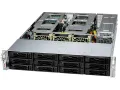
NTS Elite Vault NAS Solution | 2U Server with 12 Hot-Swap Drives + 2 M.2
The NTS Elite Vault NAS Solution is a 2U rackmount storage server designed for businesses that require centralized data storage, shared file access, backup infrastructure, and reliable storage capacity in a data center environment. With support for 12 hot-swap drive bays and 2 M.2 storage devices, the platform provides a foundation for configuring storage solutions around capacity, performance, and operational requirements.
New Tech Solutions (RackMountNTS) offers engineer-to-order configuration to help organizations align processing, memory, storage, networking, and expansion options with their intended workloads. Each proposed configuration should be reviewed for component compatibility, storage connectivity, power, cooling, and deployment requirements.
Technical Overview
The NTS Elite Vault NAS Solution is based on a 2U rackmount server platform designed for storage-intensive and enterprise infrastructure workloads. Its drive-bay configuration supports the design of centralized storage systems, while the M.2 storage positions can be evaluated for compatible boot or other supported storage uses.
Key platform features
2U rackmount form factor: Designed for integration into compatible server racks and data center environments.
12 hot-swap drive bays: Supports storage configurations that require accessible, replaceable drives without removing the entire server from service. Actual hot-swap behavior depends on the selected drives, backplane, controller, and system configuration.
2 M.2 storage positions: Provides options for compatible M.2 devices, subject to supported drive interfaces and form factors.
Processor and memory configuration: Select compatible CPU and memory options according to the supported platform and workload requirements.
Storage connectivity: Storage controller, drive interface, RAID capabilities, and supported drive types must be confirmed for the selected configuration.
Network connectivity: Choose compatible network interfaces to support file sharing, backup traffic, storage access, and integration with the existing infrastructure.
Expansion options: PCIe and other expansion capabilities depend on the selected system configuration and available slots.
Rack integration: Review rack dimensions, power delivery, airflow, cooling, cabling, and service access before deployment.
Key Benefits
High-Capacity Centralized Storage
The 12 hot-swap drive bays provide a foundation for configuring shared storage for business files, application data, project repositories, and other capacity-intensive workloads. Usable capacity depends on the installed drive sizes, selected storage layout, redundancy, and filesystem or storage software.
Flexible Storage Architecture
The combination of front-accessible drive bays and M.2 storage positions allows the storage design to be tailored to the intended use. Compatible M.2 devices may be considered for boot or other supported roles, while the primary drive bays can be configured for bulk storage or performance-oriented storage.
Simplified Drive Serviceability
Hot-swap drive support can help simplify drive replacement and maintenance when the selected backplane, controller, operating system, and storage configuration support the required service procedures. Appropriate redundancy and recovery planning remain essential.
Configurable for Business Workloads
Processor, memory, storage, and networking selections can be aligned with file services, backup, application data, and other infrastructure workloads. Proper configuration helps balance storage capacity, throughput, connectivity, and processing resources.
Rack-Efficient Deployment
The 2U design supports deployment in standard rack-based infrastructure, subject to rack compatibility and the system's installation requirements. Rack planning should account for airflow, power consumption, cabling, and access for maintenance.
Engineer-to-Order Configuration
RackMountNTS can help review workload requirements and proposed components before deployment. Configuration planning can cover storage capacity, drive compatibility, controller selection, networking, power and cooling, firmware, and system acceptance requirements.
Storage Configuration and Drive Options
The storage design should be based on capacity targets, read/write performance, redundancy, availability, and budget.
Configuration considerations include:
Number and capacity of installed drives
Supported HDD and SSD types and interfaces
Drive backplane and controller compatibility
RAID or software-defined storage requirements
Redundancy, rebuild planning, and backup strategy
M.2 device interface, form factor, and intended role
Storage throughput and network bandwidth
Operating system, filesystem, or NAS software compatibility
The 12 drive bays do not automatically guarantee support for every SAS, SATA, or NVMe drive type. Confirm the backplane, controller, drive interface, and supported drive list before finalizing the bill of materials.
GPU and Accelerator Availability
The NTS Elite Vault NAS Solution is positioned primarily as a storage server, not as a dedicated GPU server. GPU installation should not be assumed from the 2U form factor or the presence of expansion slots.
If GPU acceleration is required for a specialized workload, the exact platform must be evaluated for supported PCIe slots, physical clearance, accelerator compatibility, power delivery, thermal capacity, firmware, and driver support. Confirm the supported GPU model and quantity before including accelerators in a quote.
For conventional NAS, file-serving, backup, and storage workloads, prioritize storage configuration, memory capacity, network bandwidth, and data protection requirements.
Key Applications and Use Cases
Network-Attached Storage (NAS)
Configure centralized storage for shared business files, departmental data, project documents, and common repositories. Access methods and concurrent-user capacity depend on the selected NAS operating system, network interfaces, and software configuration.
File Sharing and Enterprise File Services
Support shared file access for teams, departments, and business applications. Storage capacity, access controls, throughput, and availability should be matched to the organization's user count and workload.
Backup and Data Protection
Use the platform as part of a backup infrastructure for storing backup sets, recovery points, and retained business data. Appropriate backup software, redundancy, access controls, and an independent recovery copy are required for a complete data protection strategy.
Media and Project Storage
Provide centralized storage for media assets, project files, design resources, and other large datasets. Performance depends on the selected drives, storage layout, network bandwidth, and number of simultaneous users.
Virtualization and Application Data
Evaluate the server for supporting application data, virtual machine storage, or infrastructure services when the selected storage architecture and software meet the application's latency, IOPS, throughput, and availability requirements.
Business Data Repositories
Support departmental databases, document repositories, archives, and other business data workloads where the selected platform and storage software meet the application's technical requirements.
Edge and Branch Office Storage
The rackmount platform can be considered for remote offices, laboratories, or branch infrastructure that requires local storage capacity. Deployment planning should include remote monitoring, maintenance access, backup connectivity, and recovery procedures.
Storage Reliability and Data Protection
A dependable storage solution requires more than drive capacity. The complete design should account for drive health monitoring, redundancy, backup policies, access permissions, and recovery testing.
Recommended planning areas include:
Appropriate RAID or software-defined storage layout
Drive health monitoring and replacement procedures
Backup retention and recovery objectives
Network segmentation and storage access controls
Firmware and software maintenance
Capacity monitoring and future expansion planning
Off-site or otherwise independent backup copies
RAID can improve availability or protect against selected drive failures, depending on the layout, but it is not a substitute for backup.
Configuration and Deployment with RackMountNTS
New Tech Solutions (RackMountNTS) supports engineer-to-order planning for commercial, federal, defense, and state, local, and education (SLED) customers.
When preparing a configuration, provide the required usable storage capacity, drive type and quantity, redundancy target, expected read/write workload, network speed, CPU and memory requirements, operating system, rack power budget, and delivery schedule.
RackMountNTS can review the proposed bill of materials for component compatibility and discuss system staging, firmware preparation, configuration validation, and delivery documentation according to the agreed project scope.
Federal, defense, and SLED procurement requirements may be aligned with SEWP V, ITES-4H, GSA MAS, or applicable cooperative purchasing vehicles when permitted by the relevant contract terms and statement of work (SOW). Contract eligibility should be confirmed for each procurement.
Request a Quote
Share your storage capacity target, number and type of drives, redundancy requirements, M.2 storage needs, network interfaces, intended workload, and deployment timeline to help define the right configuration.
Contact
NTS or submit a Request a Quote to discuss your requirements. RackMountNTS can review compatible configuration options, component availability, estimated lead times, and deployment requirements.
Related Resources
From centralized file storage to backup and business data repositories, the NTS Elite Vault NAS Solution provides a configurable foundation for storage infrastructure. RackMountNTS helps align the proposed hardware, storage design, networking, and deployment plan with the organization's operational requirements.